Your FIRE number is your yearly spending divided by your withdrawal rate: at 4%, that’s 25 times what you spend. In Australia you need two buckets: money outside super to live on until you can access super at 60, and super for the years after. Build both with a low-cost, all-growth ETF core, push your savings rate as high as you comfortably can, and add a cash buffer when you stop work.
FIRE stands for financial independence, retire early: saving and investing enough that work becomes optional. Most FIRE advice comes from the US, but in Australia super changes the maths. Here’s how to work out your number, build the portfolio with ETFs and avoid the traps, with a calculator that handles both buckets.
1. What FIRE is, and your number
Your FIRE number is the amount that can pay your spending for the rest of your life. The common rule of thumb is to withdraw 4% a year, so you need 25 times your yearly spending. Spend $50,000 a year and your number is $1.25 million; spend $40,000 and it’s $1 million.
- Lean FIRE: a lower number from a frugal budget.
- Fat FIRE: a bigger number for a more comfortable life.
- Coast FIRE: you’ve saved enough that growth alone will get you there by 60; you just need to cover today’s costs.
- Barista FIRE: part-time work covers some spending, so your portfolio needs to do less.
🎥 Watch me explain this
 ▶3:12The 20× rule and where the withdrawal rate comes fromHow much do you need to retire in Australia? · from 3:12 · read the post
- ▶1:37Start with income, not a lump sumHow much do you need to retire in Australia? · from 1:37 · read the post
2. The FIRE calculator
FIRE calculator for Australians
When could you stop working? It checks both buckets: money outside super to get you to 60, and super for the years after.
How your two buckets grow
The power of your savings rate
Illustration only, general information, not personal advice. All figures in today’s dollars: returns are after inflation and fees. Employer super is 12% of salary less 15% contributions tax, within the $32,500 concessional cap (2026–27). Doesn’t include tax on investment earnings outside super, the Age Pension (from 67), salary sacrifice or changes to your income. Super can usually be accessed from 60 once you retire.
3. The Australian twist: two buckets
Super is the best place in Australia to grow money for retirement, but you usually can’t touch it until 60. If you want to stop work at 45, you need enough outside super to carry you for 15 years first. That’s why the calculator checks both buckets.
- Don’t starve super. It’s taxed lightly and it’s the bucket that funds the longest part of your retirement.
- Don’t overfill it either. Money you put in now is locked away until 60, so balance extra contributions with building the bridge.
- Hold growth ETFs outside super for the long term, so most gains get the CGT discount, and avoid frequent trading.
🎥 Watch me explain this
 ▶48:36Tax and the distribution trapUnder the hood of an ETF with David Tuckwell · from 48:36 · read the post
 ▶6:30SMSF vs industry fundsThe retirement red zone: super, SMSFs and your last 5 years · from 6:30 · read the post
4. The FIRE portfolio with ETFs
While you’re building, keep it simple and growth-focused: you have decades, and you’re adding money every month. When you reach FIRE, you switch to the retirement system: a cash buffer, a core and satellites.
Try the split with your own numbers in Visualise your portfolio, compare fees in dollars with the ETF fee calculator, and check you don’t double up with the ETF overlap calculator.
🎥 Watch me explain this
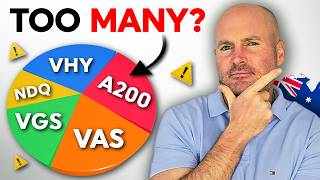 ▶4:03One-fund core vs building it yourselfHow many ETFs should you own? · from 4:03 · read the post
 ▶5:04VDHG vs DHHF: which all-in-one ETF winsVanguard vs Betashares: which ETFs win? · from 5:04 · read the post
- ▶1:53More ETFs doesn’t mean more diversificationHow many ETFs should you own? · from 1:53 · read the post
5. Your savings rate matters most
Your savings rate does two jobs at once: it adds more to your portfolio, and it lowers the spending your portfolio has to replace. On $80,000 take-home pay, saving 30% gets you to FIRE in about 20 years; saving 50% gets you there in about 12 (calculator defaults). Returns and fees matter, but you control your savings rate.
- Automate it: invest on payday, before you can spend it.
- Keep brokerage low: buy every month or two in larger amounts rather than tiny weekly buys.
- Watch lifestyle creep: every pay rise you don’t spend brings FIRE closer twice over.
🎥 Watch me explain this
 ▶3:17How much to start with, and how often to addHow to buy your first ETF in Australia · from 3:17 · read the post
- ▶8:58Build the habit, avoid the trapsHow to buy your first ETF in Australia · from 8:58 · read the post
6. 4%, 3.5% or 5%?
The 4% rule comes from US research on 30-year retirements. Early retirees may need their money to last 40 to 50 years, so many use 3.5% to be safer. Traditional retirees can often use more: our 20× rule (5%) works because the Age Pension from 67 acts as a safety net. Pick the rate in the calculator and see how much it moves your FIRE age.
7. What can go wrong
- A big fall just after you stop. Sequence risk is bigger for early retirees, because the retirement is longer. Hold a cash buffer from day one and follow the falls playbook.
- Running the bridge too thin. If the outside-super bucket runs out before 60, you can’t use super to fill the gap.
- Rule changes. Preservation age, super tax and the Age Pension can all change over a 40-year horizon.
- Health, family and housing. Budget for insurance, children and whether you’ll own your home outright.
- Purpose. Many early retirees find the hardest part isn’t money, it’s what to do with the time.
🎥 Watch me explain this
- ▶7:17Sequence of returns riskHow much do you need to retire in Australia? · from 7:17 · read the post
 ▶7:33The 3-year cash bufferHow to build a retirement portfolio with ETFs (Australia) · from 7:33 · read the post
Our free retirement plan shows your drawdown, Age Pension and a stress-tested portfolio with a cash buffer, as a PDF.
General information only, not personal advice. It doesn’t consider your objectives, financial situation or needs. Super and tax rules are complex and change; check with your fund, the ATO or a licensed adviser. Calculator results are illustrations using the assumptions shown, not predictions. ETFs named are examples, not recommendations; consider the PDS and TMD. Past performance is not a reliable indicator of future performance.
Every FIRE guide, plus the calculator, in one place.
Frequently asked questions
What is a FIRE number?
It’s the amount you need invested to cover your spending for life. At a 4% withdrawal rate, it’s 25 times your yearly spending: $1.25 million if you spend $50,000 a year.
How much do I need to retire early in Australia?
Two amounts: enough outside super to fund your spending until you can access super (usually 60), and enough in total from 60 to reach your FIRE number. Our calculator works out both.
Can I access my super early for FIRE?
Generally not. Super is usually preserved until 60 and you’ve retired, apart from limited cases such as severe financial hardship. That’s why early retirees need money outside super to bridge the gap.
What is the best ETF portfolio for FIRE in Australia?
There’s no single best, but many investors use a low-cost diversified all-growth ETF such as DHHF, or two ETFs such as A200 and BGBL, outside super, and a low-cost high-growth option in super. A cash buffer is added once you stop work.
Is the 4% rule safe in Australia?
It’s a rule of thumb from US research on 30-year retirements. For longer early retirements many people use 3.5%. Returns, fees, spending and the Age Pension from 67 all change the answer.