Build a retirement portfolio with a core of one low-cost diversified ETF (usually 60–90%) and a smaller satellite portion (10–40%) for regions, sectors, gold or income. Rather than going heavy on bonds, our view is not to go more conservative than a 70/30 growth fund like VDGR, and to manage risk with a 2–3 year cash buffer instead.
Three mistakes Australians make investing for retirement
After 20+ years as a financial adviser, I see the same three mistakes again and again:
- Investing everything in Australian shares. Australia is only about 2% of the global share market, so you miss out on the other 98%.
- Overcomplicating it with dozens of random ETFs that all overlap.
- Putting everything in one fund and hoping for the best, without a strategy.
Securing your retirement with ETFs doesn’t need to be complex. The simplest approach that works is the core and satellite model, which is how professional investors balance stability with growth.
The core and satellite approach
- Core (usually 60–90%): one low-cost diversified ETF giving you exposure to thousands of shares (and sometimes bonds). It’s your financial anchor: stable, consistent and lower risk.
- Satellites (10–40%): targeted ETFs such as Asia, healthcare, gold or dividends to add growth or income.
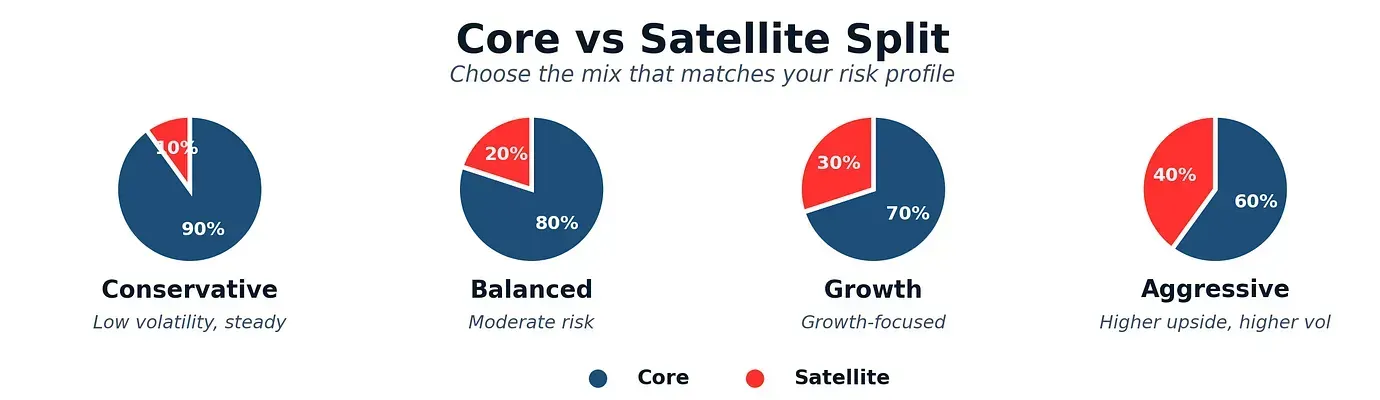
Where people go wrong: too much in satellites chasing the latest trend, or no satellites at all and missing key opportunities. Read more in core and satellite investing.
Choosing your core ETF
Choosing a core isn’t about the lowest fee or the highest past return. It’s about matching your risk tolerance and time horizon. All-in-one diversified ETFs from Vanguard and Betashares hold Australian shares, international shares and (in some) bonds, across thousands of companies, and they rebalance automatically, so you don’t have to juggle five or six funds.
Your core ETF options
Traditionally, investors moved from DHHF or VDHG towards VDBA or VDCO as they reached retirement. But conditions have changed. Bond-heavy portfolios face real risks: inflation, interest rate sensitivity and real returns that often don’t beat inflation. You can see it in the table: over three years, the conservative funds have lagged the growth funds by a wide margin.
See how each core ETF is tracking against its long-term trend in our weekly core ETF check-up, part of both Lite and Complete.
Satellite ETFs for growth and income
Satellites aren’t about buying every exciting ETF you see. They’re for filling gaps or tilting towards opportunities your core doesn’t fully capture. Your core is weighted by company size, so it leans heavily towards the US and developed markets.
- Regional tilts: for extra exposure to faster-growing economies, e.g. IAA (Asia 50) or CETF (China A50). Higher risk, so keep each to about 5–10%.
- Sectors and themes: e.g. HLTH for global healthcare, a defensive sector that benefits from an ageing population. Infrastructure, technology or clean energy are other options.
- Gold: e.g. GDX (gold miners), as an inflation and volatility hedge. Your core won’t hold gold, so it adds true diversification. Keep it to about 5–10%.
- Income: e.g. VHY for high-dividend Australian shares. Check it doesn’t overlap too much with your core.
- Cash: e.g. AAA, which pays monthly interest with very little volatility. Ideal for part of your cash buffer.
Timing matters most for satellites. We only buy at a clear buy point with a stop loss, and when our Market Health-O-Meter reads risk off, we wait. More in when to buy an ETF.
The 3-year cash buffer
This may be the most important part. If the market falls in your first few years of retirement, you may be forced to sell investments at the worst time to fund your living costs. This is called sequence of returns risk, and it can do lasting damage.
To avoid it, hold 2–3 years of expenses in cash or cash-like assets. If you need $40,000 a year, that’s about $80,000–$120,000 in a high-interest account or a cash ETF like AAA.
- When markets are up: take some profits to top up the buffer.
- When markets are down: draw from the buffer instead of selling shares at a loss, giving your portfolio time to recover.
But don’t overdo it. Too much cash loses value to inflation.
Crucial mistakes to avoid
- Overlapping ETFs. If your core is already global, adding a separate world ETF is just duplication. Every ETF should have a clear purpose. (See ETFs: the what, the why and the how.)
- Chasing performance. Last year’s winner isn’t necessarily this year’s.
- Overtrading. Hold the core through the cycle and use satellites to add value where it’s needed.
- Not rebalancing. Once or twice a year, bring your portfolio back to its target mix. It makes you sell high and buy low in a disciplined way.
General information only. Retirement decisions depend on your personal circumstances, including your super, pension eligibility, tax and health. This article doesn’t consider your objectives, financial situation or needs, and ETFs named are examples, not recommendations. Consider the PDS and TMD and speak with a licensed financial adviser before acting. Past performance is not a reliable indicator of future performance.
Frequently asked questions
What is the best ETF for retirement in Australia?
There’s no single best ETF. Many retirees use a diversified all-in-one ETF as their core, chosen to match their risk tolerance and time horizon, then add a smaller satellite portion and a cash buffer.
How much cash should a retiree hold?
A common approach is 2–3 years of living expenses in cash or cash-like assets, so you don’t have to sell shares during a downturn. Too much cash can lose value to inflation.
Should retirees hold bonds?
Traditionally yes, but bond-heavy portfolios carry inflation and interest rate risk. Our view is not to go more conservative than a 70/30 growth fund, and to manage short-term risk with a cash buffer instead.
What is sequence of returns risk?
It’s the risk of a market fall early in retirement, when you’re drawing money out. Selling investments at low prices to fund spending can permanently reduce how long your savings last.
How often should I rebalance my retirement portfolio?
Once or twice a year is common. All-in-one ETFs rebalance automatically inside the fund, so you mainly need to rebalance your core, satellites and cash buffer.