Start with one core ETF that spreads your money across thousands of companies, such as an all-in-one ETF like DHHF or VDAL, or two low-cost ETFs like A200 and BGBL. Make sure you have emergency cash first, invest money you won’t need for at least five years, add to it regularly, keep fees low and don’t sell in a panic when markets fall. Add satellites later, once you understand what you own.
Starting with ETFs can feel like a lot: hundreds of tickers, brokers, fees, tax and headlines about crashes. The good news is that you only need to get a few things right. This guide takes you through them in order, with links to the parts of my videos where I explain each one.
1. What is an ETF?
An exchange traded fund (ETF) is a fund that pools investors’ money to buy a basket of investments, such as shares, bonds or gold. When you buy one unit, you own a small slice of everything in the basket. “Exchange traded” means you buy and sell it on the ASX, just like a share.
Most ETFs follow an index. A200, for example, holds the 200 biggest companies on the ASX, so one purchase gives you all of them. Others focus on one country, sector or theme, which makes them less diversified. More in the what, why and how of ETFs and our ETF basics page.
🎥 Watch me explain this
 ▶0:38What an ETF is, in under a minuteHow to buy your first ETF in Australia · from 0:38 · read the post
 ▶2:19How a new ETF gets made, with David TuckwellUnder the hood of an ETF with David Tuckwell · from 2:19 · read the post
2. Why ETFs suit beginners
- Diversification. Spread your money across hundreds or thousands of companies instead of betting on one.
- Low cost. A fee of 0.20% a year is $20 for every $10,000 invested. Compare two ETFs in dollars with our ETF fee calculator.
- Access. One ASX trade can give you the US, Europe, Asia, bonds or gold.
- Simple to own. The fund does the buying, selling and rebalancing inside it.
🎥 Watch me explain this
- ▶1:32Why bother with ETFs?How to buy your first ETF in Australia · from 1:32 · read the post
- ▶10:44Who gets paid from your ETF feeUnder the hood of an ETF with David Tuckwell · from 10:44 · read the post
3. Are you ready to invest?
Before you buy anything, check the basics. Money you might need next year belongs in a savings account, not a share ETF.
Then decide two numbers: your starting amount and your regular top-up, such as $200 a fortnight or $500 a month. Watch brokerage: paying $10 to invest $100 is 10% gone before you start, so it can make sense to save up and buy every month or two.
🎥 Watch me explain this
- ▶2:26Are you ready to buy an ETF?How to buy your first ETF in Australia · from 2:26 · read the post
- ▶3:17How much to start with, and how often to addHow to buy your first ETF in Australia · from 3:17 · read the post
4. How to read an ETF: five things to check
Don’t worry if an ETF trades only a few times a day. Market makers keep the price close to the value of what the fund holds, so low volume doesn’t mean you can’t sell. To see what a fund really holds, look it up on our ASX ETF list or compare two with Compare ETFs. More on currency in hedged vs unhedged ETFs.
🎥 Watch me explain this
 ▶0:45The key terms on an ETF fact sheetVanguard ETFs explained · from 0:45 · read the post
 ▶0:43Hedged vs unhedged, explainedHedged vs unhedged ETFs explained · from 0:43 · read the post
- ▶31:23Low volume doesn’t mean hard to sellUnder the hood of an ETF with David Tuckwell · from 31:23 · read the post
5. Pick your core: one ETF or two
Your core is the long-term base of your portfolio: broad, low cost and held through the ups and downs. Most beginners only need this.
Australia is only about 2% of the world’s share market, so an Australian-only ETF like VAS or A200 on its own puts a lot in one country. A core with global shares spreads that risk. Not sure which mix suits you? Picture $10,000 falling to $7,000 in a downturn. If you’d hold on, 100% shares may suit you; if you’d sell, choose an option with some bonds. See VDHG vs VAS and VGS and DHHF vs VDAL.
🎥 Watch me explain this
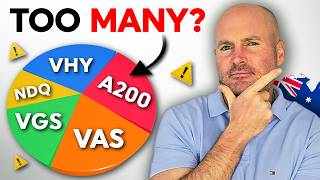 ▶4:03One-fund core vs building it yourselfHow many ETFs should you own? · from 4:03 · read the post
 ▶9:06One ETF or two: fees, tax and controlVDHG vs VAS and VGS: one ETF or two? · from 9:06 · read the post
 ▶5:04VDHG vs DHHF: which all-in-one ETF winsVanguard vs Betashares: which ETFs win? · from 5:04 · read the post
6. Later: add satellites (core and satellite)
Once your core is in place, you can add a few satellites: smaller holdings in parts of the market the core doesn’t focus on, such as gold, resources or a strong theme. This is how we invest: about 80% core and 20% satellites.
Satellites are harder. We only buy them when they move from a base into an uptrend, and we sell them when the trend breaks. While nothing is setting up, that money sits in cash. If that sounds like too much work, a core on its own is a perfectly good portfolio. More in core and satellite investing and when to buy an ETF.
🎥 Watch me explain this
 ▶6:27The core and satellite approachWhere Does the Money Go When the Market Crashes? · from 6:27 · read the post
 ▶8:22Lesson 7: core and satellite7 ETF investing lessons from 20 years · from 8:22 · read the post
- ▶0:24Lesson 1: cash is a position7 ETF investing lessons from 20 years · from 0:24 · read the post
7. How many ETFs, and watch the overlap
More ETFs doesn’t mean more diversification. Many ETFs hold the same big companies, so owning VGS, IVV and NDQ means owning Apple, Microsoft and Nvidia three times. One to three ETFs is plenty when you start; we suggest no more than 10 in total, with one core.
Check how much your ETFs double up with our ETF overlap calculator. More in how many ETFs should I own?
🎥 Watch me explain this
- ▶1:53More ETFs doesn’t mean more diversificationHow many ETFs should you own? · from 1:53 · read the post
 ▶1:42:25Can you be over-diversified?Live ETF Q&A: Tech breaks down as the Aussie market finds its feet · from 1:42:25 · see the Q&A notes
- ▶1:01:54“I hold seven ETFs and I’m worried about overlap”Live ETF Q&A: Tech breaks down as the Aussie market finds its feet · from 1:01:54 · see the Q&A notes
8. Placing your first order
- Open a broker account and link your bank account. Compare brokerage, and check whether you’re on the CHESS register (shares held in your name) or held by the broker.
- Search the ticker, such as DHHF, and check the name matches.
- Use a limit order: set the most you’re willing to pay, close to the current price. It protects you from paying more than you meant to.
- Trade during ASX hours (10am to 4pm Sydney time), and avoid the first half hour, when prices can be less accurate.
- Set up regular investing so adding money becomes a habit.
The step-by-step version is in how to buy your first ETF in Australia.
🎥 Watch me explain this
- ▶7:14Placing the order, step by stepHow to buy your first ETF in Australia · from 7:14 · read the post
- ▶26:44Should I use limit orders or buy at market?Live ETF Q&A: Tech breaks down as the Aussie market finds its feet · from 26:44 · see the Q&A notes
- ▶25:52Why not to trade before 10:30amUnder the hood of an ETF with David Tuckwell · from 25:52 · read the post
9. When markets fall
They will. Share markets have fallen 20% or more many times and recovered over time. If you don’t sell, you still own the same number of units; the price has changed, not what you own. Selling in a panic is what turns a fall into a real loss.
Keep your core invested and keep adding to it. Have cash set aside so you never need to sell at the bottom. More in where does the money go when markets crash?
🎥 Watch me explain this
- ▶3:24Have you lost anything if you don’t sell?Where Does the Money Go When the Market Crashes? · from 3:24 · read the post
- ▶5:48What to do when markets fallWhere Does the Money Go When the Market Crashes? · from 5:48 · read the post
10. Costs and tax: the short version
- Fees come out of the fund’s price, so you don’t pay a bill. Brokerage is charged each time you buy or sell.
- Distributions are taxable each year, even if you reinvest them. Australian share ETFs often come with franking credits. See franking credits and ETFs.
- Capital gains are taxed when you sell. Holding for more than 12 months can reduce the tax, and the rules change from 1 July 2027. Try our CGT 2027 calculator.
- Keep your annual tax statements, because they adjust your cost base.
🎥 Watch me explain this
- ▶10:10Costs and tax, the short versionHow to buy your first ETF in Australia · from 10:10 · read the post
- ▶48:36Tax and the distribution trapUnder the hood of an ETF with David Tuckwell · from 48:36 · read the post
11. Beginner mistakes to avoid
- Buying too many ETFs that hold the same companies.
- Chasing last year’s winner. A theme that rose 50% can fall just as fast.
- Only owning Australia. You likely already earn your income and own property here.
- Picking ETFs for the dividend alone. Look at total return: price growth plus distributions.
- Paying too much brokerage on small, frequent buys.
- Stopping when markets fall, which is often when regular investing helps most.
🎥 Watch me explain this
- ▶8:58Build the habit, avoid the trapsHow to buy your first ETF in Australia · from 8:58 · read the post
- ▶4:27Lesson 4: home bias and currency7 ETF investing lessons from 20 years · from 4:27 · read the post
- ▶7:30Lesson 6: total return before dividends7 ETF investing lessons from 20 years · from 7:30 · read the post
12. Your starter checklist
- Emergency cash set aside, no high-interest debt.
- Choose your core: one all-in-one ETF, or two low-cost ETFs.
- Open a broker account and buy with a limit order.
- Set up a regular amount and keep adding.
- Check overlap and fees once a year, and rebalance if you hold two or more ETFs.
Ready for a plan with dollar amounts? See how to build a $10k ETF portfolio. Want to know how much you need? Try the ETF income calculator. All our free tools are on the ETF calculators page.
Enter them in our free portfolio check to see your overlap, fees and core/satellite mix, with a PDF report.
General information only, not personal advice. It doesn’t consider your objectives, financial situation or needs. ETFs named are examples, not recommendations; consider the PDS and TMD before investing. Fees from the TMX Australia funds report (September 2026) and may change. Past performance is not a reliable indicator of future performance.
Frequently asked questions
How do I start investing in ETFs in Australia?
Make sure you have emergency cash and no high-interest debt, open a broker account, choose one diversified core ETF (or two low-cost ones), buy with a limit order during ASX hours, then add a regular amount over time.
What is the best ETF for beginners in Australia?
There’s no single best, but beginners often start with an all-in-one ETF such as DHHF or VDAL (100% shares) or VDHG (about 10% bonds), because one fund gives you Australian and global shares and rebalances itself.
How much money do I need to start investing in ETFs?
Your first purchase of any ASX ETF must be at least $500. After that you can add smaller amounts, but watch brokerage on small trades.
How many ETFs should a beginner own?
One to three is plenty. More ETFs often means more overlap and brokerage, not more diversification.
Are ETFs safe?
ETFs are a way to own investments, not a guarantee. A share ETF can fall 30% or more in a downturn. Broad, diversified ETFs spread the risk across many companies, but their value still goes up and down with the market.