ETFs that hold Australian shares pass on franking credits from the companies they own. Broad ETFs like A200 and VAS are typically around 70% franked, and high-yield ETFs can be higher. Franking credits are worth the most to people on low tax rates, such as retirees and super funds in pension phase, who can get the excess back as a refund. Global ETFs pay little or no franking, and some ETFs structured through US funds can lose it.
What are franking credits?
When an Australian company pays tax on its profits (usually 30%) and then pays you a dividend, it attaches a franking credit for the tax it has already paid. It stops the same profit being taxed twice: once in the company and again in your hands.
Example: a company earns $100, pays $30 tax and pays you a fully franked dividend of $70, with a $30 franking credit. At tax time you declare $100 (the “grossed-up” amount), work out the tax at your rate, then subtract the $30 credit. If the credit is more than your tax, the ATO refunds the difference.
How franking flows through an ETF
An ETF is a trust. When the companies it holds pay franked dividends, the ETF passes both the cash and the franking credits on to you in its distributions, usually quarterly.
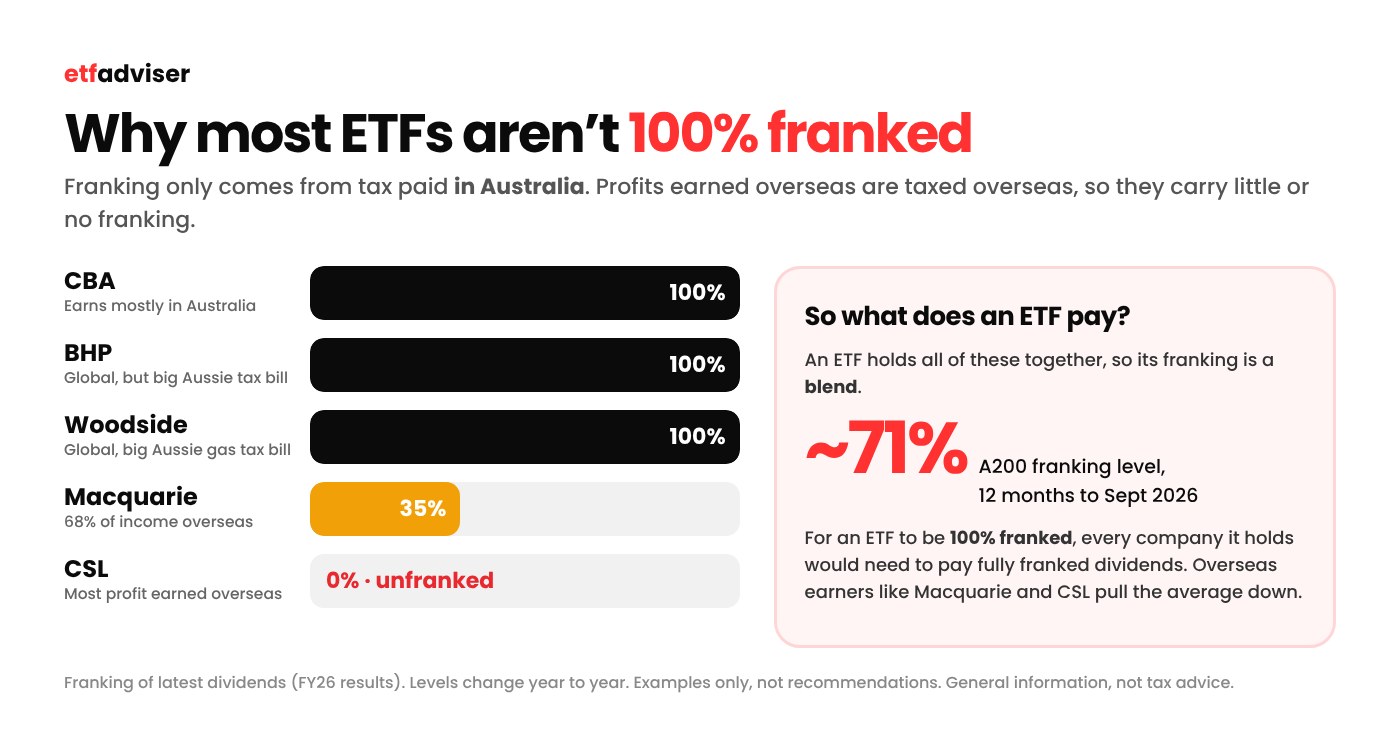
An Australian share ETF is unlikely to be 100% franked, because not all Australian companies pay fully franked dividends. Companies that earn profits overseas, like CSL and Macquarie, pay little or no franking, which pulls the ETF’s franking level down.
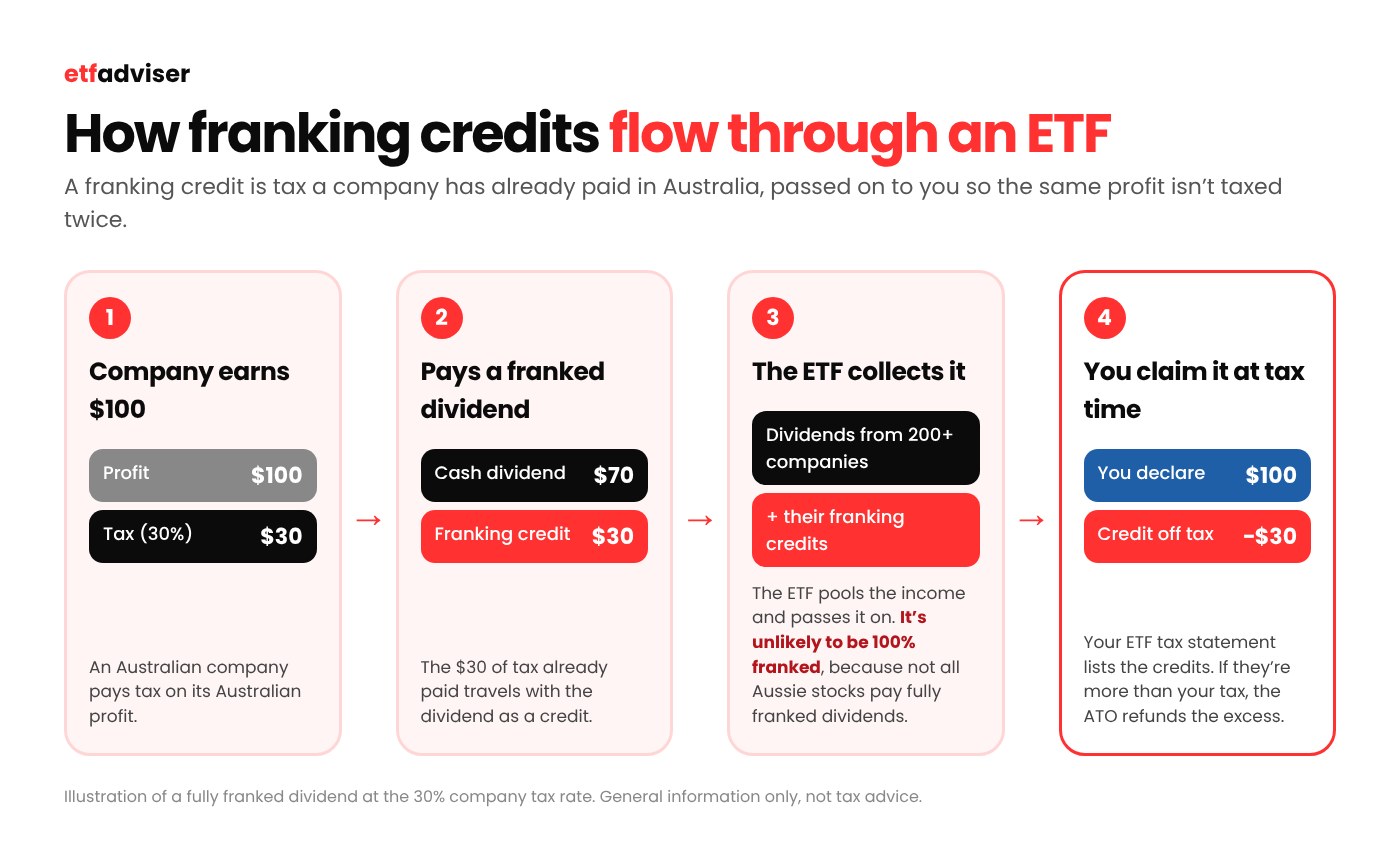
- Your AMIT tax statement from the ETF shows the franking credits to include in your tax return.
- A fund’s franking level is the share of its income that comes with credits. For example, A200’s franking level was about 71% over the 12 months to September 2026, with a cash yield of 3.3% and a grossed-up yield of about 4.3% (Betashares fact sheet).
- To claim franking credits you generally need to hold for at least 45 days around the dividend (the holding period rule). Individuals with less than $5,000 in franking credits a year are usually exempt.
What franking credits are worth to you
The lower your tax rate, the more a franking credit is worth. Here’s what a fully franked $70 dividend leaves you after tax, compared with an unfranked $70:
| YOUR TAX RATE | TAX ON $100 GROSSED UP | NET FROM $70 FRANKED | NET FROM $70 UNFRANKED |
|---|---|---|---|
| 0% (e.g. super in pension phase) | $0 | $100 incl. $30 refund | $70 |
| 15% (super, accumulation) | $15 | $85 | $60 |
| 32% (30% + Medicare) | $32 | $68 | $48 |
| 39% (37% + Medicare) | $39 | $61 | $43 |
| 47% (45% + Medicare) | $47 | $53 | $37 |
At 0% tax you keep the whole $100, including a $30 refund. At the top rate, franking still saves you tax, but much of the credit is used up.
Which ETFs pay franking credits?
Only ETFs that hold Australian companies pass on franking. Global share, bond and cash ETFs pay little or none.
Even among Australian companies, franking only comes from tax paid in Australia. CBA earns most of its profit here and pays fully franked dividends. BHP and Woodside are global, but they pay enough Australian tax (largely from WA iron ore and gas) to fully frank their dividends. Macquarie earns about 68% of its income overseas, so its latest dividend was only 35% franked, and CSL, which earns most of its profit overseas, pays unfranked dividends. That’s why a broad ETF is unlikely to be 100% franked: not all Australian companies pay fully franked dividends, so its franking is a blend of everything it holds.
Within Australian shares:
- Broad market ETFs (, , ) hold the whole market and are typically around 70% franked.
- High-yield and dividend ETFs (, , , , ) tilt towards higher-paying companies such as the big banks, BHP and Telstra, so their income and franking are usually higher.
- Active income and covered call ETFs (, , ) aim for more income, but strategies like option selling can change how much is franked.
Franking examples: VHY, VAS, A200 and IOZ
Tap any ETF for a chart, details and similar ETFs.
| ETF | FRANKING LEVEL | CASH YIELD | GROSSED-UP YIELD |
|---|---|---|---|
| · high yield | ~85–90% | ~5.5% | ~7.5% |
| · ASX 300 | ~70–80% | ~4.0% | ~5.5% |
| · ASX 200 | ~80% | ~4.0–4.5% | ~5.5% |
| · ASX 200 | 71% | 3.3% | 4.3% |
| ETF | STYLE | FEE | SIZE | 1 YR |
|---|---|---|---|---|
Betashares Australia 200 | Broad market: ASX 200 | 0.04% | $11.1bn | +2.9% |
Vanguard Australian Shares Index | Broad market: ASX 300 | 0.07% | $26.7bn | +2.2% |
iShares Core S&P/ASX 200 | Broad market: ASX 200 | 0.05% | $9.7bn | +2.6% |
Vanguard Australian Shares High Yield | High yield | 0.25% | $8.2bn | +12.0% |
State Str SPDR MSCI Aus Select High Div Yield | High yield | 0.20% | $739m | +14.8% |
iShares S&P/ASX Div Opportunities Esg Screened | Dividend opportunities | 0.23% | $407m | +8.8% |
Global X S&P/ASX 200 High Dividend | High dividend | 0.24% | $100m | +10.7% |
Russell Investments High Dividend Aus. Shares | High dividend | 0.34% | $342m | +1.9% |
Betashares Aus Dividend Harvester Active | Dividend harvester (active) | 0.72% | $278m | – |
Ausbil Active Dividend Income Fund - Active | Dividend income (active) | 0.85% | $620m | +7.0% |
Betashares Aus Top 20 Eqy Yield Max Complex | Covered call: top 20 | 0.76% | $696m | +1.8% |
Browse every income ETF on our dividend and income ETFs list, or compare the broad funds in VAS vs A200.
The feeder-fund trap
When I spoke with David Tuckwell (CIO, ETF Shares), he explained that a small number of ASX-listed ETFs are feeder funds: they simply hold a US-listed version of the same fund. A US-domiciled fund falls under US tax rules, and that can strip out franking credits on Australian shares.
“On our numbers almost 98% of ETFs trading on the ASX are not feeder funds. It’s just a select few of them.”David Tuckwell, CIO & co-founder, ETF Shares
Read the full interview: ETFs under the hood with David Tuckwell.
What to watch out for
- Don’t let franking drive the whole decision. A big dividend doesn’t help if the share price keeps falling. Look at total return first, then decide whether the income suits you.
- Concentration. High-yield ETFs lean heavily on banks and miners. Australia is only about 2% of the global share market, so going all-in on local shares for franking means missing most of the world.
- Tax timing. Buying just before a distribution can mean paying tax on income you effectively bought back (see David’s chapter on the distribution trap above).
- The 45-day rule if you trade in and out around distributions.
Who benefits most?
- Retirees on low or zero tax, who can receive excess credits as a cash refund.
- SMSFs, especially in pension phase (0% tax) and accumulation (15%).
- Low-income investors and anyone whose credits exceed their tax.
For higher-income earners, franking still reduces tax, but the benefit is smaller, so global diversification and growth often matter more. That’s why we use a mix: a diversified core with both Australian and global shares. See ETFs for retirement and core and satellite investing.
General information only, not tax advice. Tax rules, rates and thresholds can change and depend on your circumstances; check with the ATO or a registered tax agent. ETFs named are examples, not recommendations. Past performance is not a reliable indicator of future performance.
Frequently asked questions
Do ETFs pay franking credits?
Yes, if they hold Australian companies that pay franked dividends. The ETF passes the credits on to you with its distributions, and they appear on your annual tax statement. Global share, bond and cash ETFs pay little or no franking.
Which ETF has the highest franking credits?
High-yield Australian share ETFs such as VHY, SYI and IHD usually pay more franked income than broad market ETFs, because they hold more high-dividend companies like the big banks. Franking levels vary from year to year, so check each fund’s distribution history.
How much franking does A200 or VAS pay?
Broad Australian share ETFs are typically around 70% franked. Betashares reported A200’s franking level at about 71% for the 12 months to September 2026.
Can I get franking credits refunded?
Yes. If your franking credits are more than the tax you owe, the ATO refunds the excess. This is especially valuable for retirees and super funds in pension phase.
What is the 45-day rule for franking credits?
To claim franking credits you generally need to hold the shares or ETF units “at risk” for at least 45 days around the dividend. Individuals whose total franking credits are under $5,000 a year are usually exempt.