For most people, ETFs are the simplest way to reach FIRE. They’re cheap, spread your money across thousands of companies, and, most importantly for an early retiree, you can sell a little at a time to pay your bills. Property can build wealth with leverage, but you can’t sell one bedroom when you need $50,000.
Almost every FIRE plan you’ll read about is built on low-cost index funds. In Australia, that usually means ETFs. But are they really better than property or picking your own shares? Here’s how they compare, and the ETF portfolio we’d use.
1. Why ETFs suit FIRE
- Low fees. Over 30 years, a 1% difference in fees can cost you about a quarter of your final balance. Broad ETFs cost a fraction of that.
- Diversification. One trade buys hundreds or thousands of companies, so one company’s failure can’t sink your plan.
- Easy to add to. You can invest every pay, in amounts as small as a few hundred dollars.
- Easy to draw on. When you retire, you sell what you need. That’s hard to do with property.
- Franking credits. Australian share ETFs pass on franking credits, which can be refunded in retirement if you pay little tax.
🎥 Watch me explain this
 ▶1:32Why bother with ETFs?How to buy your first ETF in Australia · from 1:32 · read the post
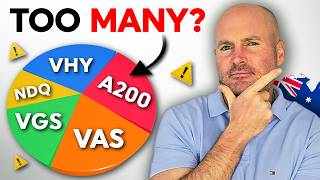 ▶4:03One-fund core vs building it yourselfHow many ETFs should you own? · from 4:03 · read the post
2. ETFs vs property vs shares vs super
3. What about property?
Property has made many Australians wealthy, mostly through leverage: borrowing 80% means a 5% rise in price is a 25% gain on your deposit. But for FIRE it has three problems. Rent after costs is often only 2% to 3% a year, so it doesn’t pay much to live on. You can’t sell part of it. And your money sits in one asset in one place. Many people who reach FIRE through property sell up and move into shares when they stop work. We compared them over 140 years in ETFs vs property.
🎥 Watch me explain this
 ▶2:50ETFs vs property over timeETFs vs property: which builds more wealth? · from 2:50 · read the post
- ▶11:34The verdictETFs vs property: which builds more wealth? · from 11:34 · read the post
4. A FIRE portfolio with ETFs
Keep the core simple. One diversified all-growth ETF, or two covering Australia and the world, is enough. If you want to try to do better, keep any satellites to 20% and only buy them when they’re in an uptrend. Our core and satellite guide explains how, and the trend scanner shows which ETFs are trending.
Use the same idea in super: a low-cost, high-growth or indexed option, or an SMSF holding similar ETFs. Our full FIRE portfolio guide goes through both buckets.
Our free FIRE calculator checks both buckets: money outside super to get you to 60, and super for after.
5. Drawing down: the part most people forget
Getting to your number is half the job. Once you stop work, you need a way to pay yourself that doesn’t force you to sell after a fall. We use a cash buffer: spend from cash, top it up from your ETFs after good years, and leave your shares alone after bad ones. See how to pay yourself from ETFs.
🎥 Watch me explain this
 ▶1:06The core and satellite approachHow to build a retirement portfolio with ETFs (Australia) · from 1:06 · read the post
 ▶8:22Core and satellite, lesson 77 ETF investing lessons from 20 years · from 8:22 · read the post
Every FIRE guide, plus the calculator, in one place.
Frequently asked questions
Are ETFs good for FIRE?
Yes. They’re low cost, diversified and easy to buy and sell in small amounts, which makes them well suited to both building your FIRE number and drawing on it later.
What is the best ETF for FIRE in Australia?
There isn’t one best ETF, but many FIRE investors use a diversified all-growth ETF such as DHHF or VDHG, or a two-ETF mix of Australian and global shares. These are examples, not recommendations.
Is property or ETFs better for FIRE?
Property can grow wealth faster with leverage, but it pays little after costs and you can’t sell part of it. ETFs are easier to draw on in retirement. Many people use both, then simplify into shares when they stop work.
How many ETFs do I need for FIRE?
One to three for the core is plenty. More ETFs often means more overlap, not more diversification.
Should I invest for FIRE inside or outside super?
Both. Super is low-tax but locked until 60, so you also need money outside super to cover the years between stopping work and 60.